Article · Saturn
Saturn: When It Is Enough
Saturn in life, history and the twelve signs
Pavel Medvedev · Published:

The desk already stands level. Its drawers open, its edge does not catch a sleeve, and the lamp lights the working surface. Yet the maker keeps finding things to change. He could sand the wood again. Replace the handles. Look for a better shade.
The customer comes to collect it for the third time. She needs a desk she can work at; he finds it increasingly hard to say, “It's ready.” Their disagreement is not about a love of craftsmanship. They have not yet agreed on what result is sufficient for the use that was promised.
In the reading proposed here, Saturn helps establish precisely that. What has been done, what we undertake, where the promise ends and what circumstances would require us to revisit the decision. Sometimes the answer completes a piece of work. Sometimes it lets us begin without turning a first step into a lifelong commitment.
Such a limit can protect both the work and the person. It need not be the narrowest possible limit. If the desk is unstable, “Enough” comes too soon. If it is fit for the agreed work, endless revision does not become a virtue merely because it takes effort.
How a restriction became an inner support
In ancient astrology, Saturn belonged to the seven familiar heavenly lights. Ptolemy associated it primarily with cold and partly with dryness. These qualities were contrasted with heat and moisture, which were thought to nourish and support growth. This is not yet a modern discussion of personal boundaries, although a later reader can readily hear a familiar echo.
Alongside the astrological image lives the Greek myth of Cronus, who swallows his children for fear of losing power. In Hesiod's Theogony, that fear does not save him from the succession of generations. The story invites thought about a limit someone tries to make eternal: preserving an order turns into destroying the very life that order might have served.
Bringing myth into conversation with human life calls for care. Not every refusal is repression, nor every rule a fear of the new. A parent who stops a child from taking a hot saucepan and a manager who forbids any independent decision are doing different things. What matters is the content of the restriction and whom or what it serves.
In the teaching materials of Pavel Andreev's school, Saturn becomes an inner backbone: discipline, responsibility, the capacity to plan and carry work through. Respect for other people's time and space appears there too. Support is no longer merely a command from above to endure.
Taking this a step further, responsibility can be expressed in very ordinary words: “Here is what I promise. Here is what I take responsibility for. Here is what I have not yet checked.” Such speech may sound less impressive than “I'll keep everything under control,” but it gives others much more genuine certainty.
A world that can be completed
On the World card, a figure stands within a wreath. Four images occupy the corners, while movement remains at the centre. The closed outline can be read as completion within which life continues.
In the author's pairing, this card helps us see Saturn without compulsory gloom. A finished book does not forbid the writer's next book. A completed conversation does not rule out a future meeting. Finishing one round of work allows us to use its result instead of keeping our entire existence in perpetual draft.
The wreath, however, tells us nothing on its own about the quality of a particular desk or the accuracy of a promise. The image becomes useful when we name what we consider complete. “Everything is finished” is often too broad. “This version is ready to read at home; before printing, we still need to check the illustrations” is an intelligible commitment.
Marina's evening need not contain all of music
Let us return in imagination to Marina from the articles on Jupiter and Neptune. She is preparing a musical evening at a library. After every rehearsal she wants to add one more piece, one more story, one more important connection. Eventually the programme begins to collapse under the weight of its wonderful additions.
Marina and the librarian agree: the gathering will last an hour, with three works and a conversation with the audience. This does not declare the remaining music less valuable. It answers what, precisely, they are promising people that evening.
Having a room and enough energy belongs to the available possibilities discussed through Jupiter. Choosing favourite pieces brings us back to Venus. Saturn appears in the definite commitment: how long the gathering lasts, what is prepared, who ends it on time and what would justify revising the plan.
Enjoying the programme is no substitute for such clarity. Someone may be delighted and forget that the library closes at eight. Someone may be tired of rehearsing while the order of appearances remains unchecked. “I've had enough” and “The promised work is ready” sometimes coincide, but they answer different questions.
A good limit does not forbid the unexpected. If a listener asks an important question, the conversation can change. But Marina then knows what she is removing from the programme, rather than quietly passing the cost of her decision to the person who has to close the building.
Twelve signs: twelve ways of giving a promise its outlines
We will now meet Saturn in beginnings, objects, conversation, closeness, creativity and shared rules. We will look for limits that participants understand and that fit the task. This is neither a contest in strictness nor a division of people into responsible and irresponsible according to their birth sign.
Saturn in Aries

The neighbours want to open a Sunday repair workshop in the courtyard. At the first meeting, several say, “We're with you.” A week later, it turns out that one meant helping on the first day, another a monthly shift, and a third simply support for the idea.
The beginning was encouraging, but the promises had not acquired clear outlines. Now the participants agree on a trial gathering: two hours, simple household objects, everyone bringing their own tools. Afterwards they will decide whether to continue. Agreeing to come on Sunday no longer quietly becomes an indefinite obligation.
Saturn makes it possible to begin here. There is no need to perfect the entire future project in advance. The first area of responsibility needs to be named clearly enough. If nobody has opened the room or set out the tables yet, the agreement itself does not replace the actions of Mars.
The Emperor helps us imagine a beginning with its territory marked out. But clarity is not the same as rule by one person. Everyone can decide together which first step they are genuinely prepared to regard as shared and which questions remain open.
Saturn in Taurus

The customer accepts the desk. The maker explains: the surface can take everyday work, the drawers are adjusted and it does not wobble. He has not prepared it for an open veranda; after its first winter of indoor heating, he asks her to have the joints checked. The object acquires an intelligible range of use.
This is more useful than either extreme. “It will last forever” conceals the actual conditions. “I take no responsibility; wood is a living material” excuses the maker even from the obligation he could fulfil. Between them lies a definite piece of work whose quality he can answer for without promising the impossible.
Stability in Taurus does not mean that nothing will ever change. Wood dries, loads vary, the desk moves into another room. Completion therefore includes an intelligible reason to return to the check. Each new inspection applies the existing condition; a new condition arises only when that condition is actually revised.
The Hierophant recalls tested craft knowledge, which helps us name sufficiency more accurately. Whether the customer likes the shade concerns her taste. Whether a large desk is workable at all concerns the room's possibilities. What the maker takes responsibility for in this object is a separate Saturnian question.
Saturn in Gemini

An editor sends an author a cover and receives the reply, “Yes, that's good.” He sends the book to print. The author protests: she approved the colour but had not seen the latest subtitle. Both remember agreement, yet attach it to different things.
The next email is fuller: “I approve this cover with this subtitle for this print run. I am still checking the back-cover text.” Words that initially look unnecessary remove an unwarranted assumption. Part of the discussion is settled; another part remains open.
Mercury is needed for both people to understand the email in the same way. Saturn helps us see precisely what commitment now holds. Someone may understand “I like it” perfectly well and still mistake pleasure for permission to print. A clear meaning and a definite force to the answer therefore need separate attention.
Beside the Lovers, this becomes care for the meeting of two people. Neither has to guess how far the other's “yes” extends. If the decision needs changing, they already know which agreement they are returning to and whom to tell.
Saturn in Cancer

Liza cares for a close relative and increasingly stays longer than she intended. Nobody explicitly demands it. Every unfinished conversation, forgotten purchase and anxious question simply becomes her concern, little by little.
The family agrees in more detail: today Liza will stay until seven, prepare supper and leave information about unfinished matters for the next person. Her brother will arrange tomorrow's journey. If circumstances change, they will discuss that separately. Love does not disappear because an evening has an end time.
The Moon helps them notice tiredness, anxiety and the response that fits the present moment. Venus helps them understand what they cherish in this closeness. Saturn makes the accepted commitment distinct. Liza can go on worrying after seven without being the only person responsible for the whole night ahead.
The Chariot recalls a shared movement. Handing over care requires the next participant to be genuinely able to take it up. Simply leaving a promise unfulfilled is not the same as defining the limits of responsibility. But indefinitely filling every gap with oneself is not the only way to remain faithful to loved ones either.
Saturn in Leo

Marina listens to the recording of her story and wants to revise the ending again. Every version opens another possibility. If she can stop only when no better version is imaginable, the library evening will never happen.
She returns to the intention of this gathering: the listener should hear the exchange between two melodies, pass through three episodes and have room for a question of their own. This already works. Other possibilities remain, but they are not required for this evening. Marina saves the recording and finishes preparing this version.
Strength is needed here partly for stopping. Completion is not a loss of interest, nor does it require declaring the work the best it could ever be. Next season can bring a new version. The present one already fulfils its purpose.
The Sun asks about an author's own decision; Saturn asks about the sufficient readiness of a particular work. They are easily confused when “having arrived” means both finding a voice and finishing. An author's voice can sound in an unfinished sketch. A finished performance of someone else's piece can be fully ready without a new composition being created.
Saturn in Virgo

A library employee tests a new page holder. It works for three art books but leaves a mark on thin paper. What matters now is not hiding the unwelcome finding behind a general “Tested.”
She specifies the bindings and pages the device suits, those not yet checked and when it needs to be removed. It is not yet approved for rare, fragile editions. This qualification does not devalue successful work; it lets people use it without false confidence.
The Hermit beside Saturn keeps attention on the particular check. A completed trial concerns specific conditions. If a book of a different size arrives tomorrow, it cannot silently be included in the earlier promise merely because it too is called an art book.
Mercury helps staff understand the restriction in the same way. Mars helps carry out the necessary test. Saturn connects the result to what may now be regarded as permissible. This is not endless suspicion of everything new. After sufficient checking, it is precisely what allows a clear “yes” within an area someone can take responsibility for.
Saturn in Libra

Two illustrators agree to split the cost of an exhibition equally. Later, one orders expensive frames and regards half the bill as the other's debt. The second thought they meant the room hire. A friendly agreement proved too broad for two different expectations.
Now they list shared expenses, set a sum beyond which fresh agreement is needed and decide what happens if the date changes. Working together becomes freer: each knows which decisions have been made and where the other still needs to be consulted.
Justice beside Saturn here means a definite mutual promise. It does not demand that all relationships become bookkeeping. Detail is needed where an unspoken assumption could turn into someone else's debt. Sometimes a single, timely clarification is enough.
Pluto helps examine who can impose an expense on the other person at all and whether it can be resisted. Saturn concerns the outlines of the agreement itself. A new clarification need not alter the distribution of power between partners, although it can become part of a deeper change.
Saturn in Scorpio
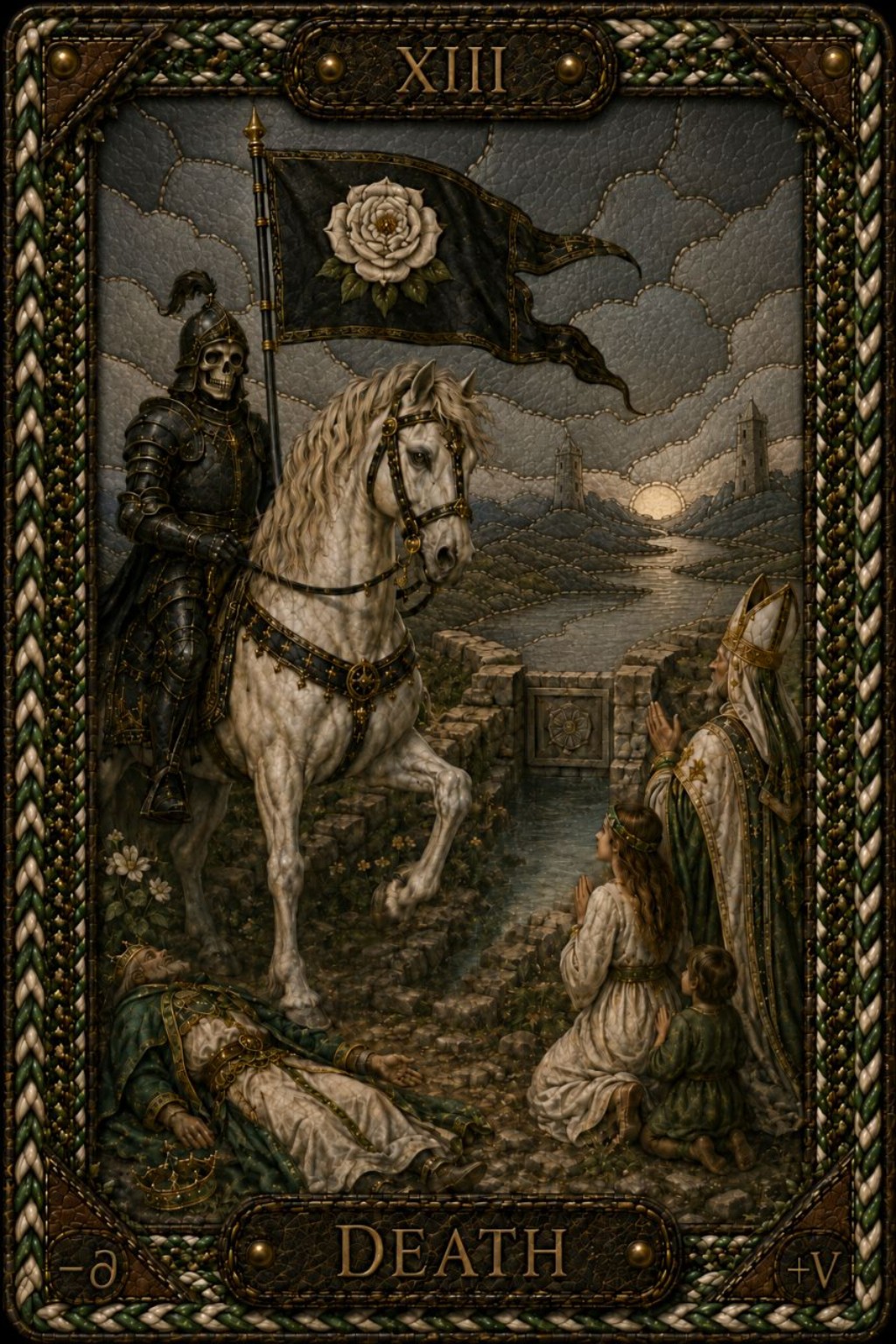
A music club closes. Its last evening is over, the sign has come down, people have said goodbye. But an unpaid bill, a borrowed microphone and recordings promised to performers remain. The end of the gatherings has not yet completed every obligation.
The organisers separate these matters: there will be no new events; equipment will be returned on Friday; accounts will be settled by a specified date; one participant will take care of the archive. The ending acquires actual outlines. Nobody has to keep the club alive indefinitely to finish what remains.
Death helps acknowledge an ending; Saturn helps us avoid concealing unfinished business within the word. Yet not every trace of the past is a debt. Sadness may return after all obligations have been met. A person need not declare themselves fully healed in order to close the club's account.
Neptune asks what from its life might continue differently. Saturn helps name what is genuinely finished and what still calls for an answer. Such clarity can make room for grief: the pain of parting no longer has to be confused with an endless “We still owe something.”
Saturn in Sagittarius

A group reads a difficult book. Every page raises questions that would require ten more books. If moving on is allowed only after complete knowledge of everything connected to it, the first chapter becomes a permanent residence.
The participants decide what is sufficient for this stage: being able to state the main line of thought in their own words, give an appropriate example and mark what remains unclear. They write down uncertainties to return to later. Continuing no longer requires pretending to know everything.
Temperance lets us see how stages connect. Here a limit helps the journey continue. It differs from an expansion of possibilities: the library may open access to a hundred new books, but that does not say when to finish discussing the present chapter.
Nor does completing a stage prove that the chosen direction is right forever. If the next chapter reveals a substantial misunderstanding, they will revisit their earlier decision. Saturn need not turn every “Enough for the next step” into a final ruling on all future thought.
Saturn in Capricorn

Everything for the exhibition is ready separately: pictures are hanging, lights work, captions are printed. Yet a wheelchair user cannot pass between the stands, and the attendant does not know where to get the key to the emergency exit. Ready parts have not yet made a ready whole.
The organisers walk through the visitor's entire route, check the handover between shifts and clarify who deals with questions. Now they can name the conditions under which the exhibition is genuinely prepared to operate. Evening openings and large school groups still need additional arrangements.
The Devil recalls the ties connecting separate parts, sometimes holding them in an awkward dependency. Saturn helps us avoid mistaking a tidy checklist of completed tasks for a functioning whole that delivers what was promised. The check need not anticipate absolutely every possible event: its scope relates to the exhibition's purpose.
The Sun concerns the conception of its arrangement. Pluto concerns who has the authority to change how powers are distributed. Saturn asks a more definite question: what operation of all this together can the organisers already answer for to a visitor?
Saturn in Aquarius

A network of libraries adopts a common rule for musical gatherings: free admission, an announced duration and an opportunity to ask questions. One small room cannot accommodate everyone who wants to attend. If the rule is treated as a promise of unlimited space, the library will be at fault simply for the size of its walls.
The participants clarify what free admission means with limited capacity, how to announce registration, which exceptions are acceptable and when to review the rules. What they share becomes more definite while differences between venues remain. The rule can be applied without constant guesswork about its authors' intentions.
The Star helps us see an invitation addressed to many people. The wider the circle, the more important it is not to pass a local convenience off as a universal condition. Yet an endless “Everyone understands it their own way” empties the common promise of content.
Uranus may help find a more accurate distinction between types of gatherings. Pluto may change who decides a disputed exception. Saturn concerns the definition of the current arrangement: where it applies, what it requires and when it ceases to be sufficient. A good rule allows a stated review without turning every application into a fresh argument about everything.
Saturn in Pisces

Liza prepares a family story from a few letters. One confirms that her grandmother intended to move. It does not confirm that the move happened, nor explain the silence that followed. An appealing, complete story still rests on incomplete evidence.
Liza keeps distinctions in the text: this is known, this is likely, this could not be established. She can finish the present version without declaring the entire family history settled. A new letter will be an intelligible reason to revisit a conclusion.
The Moon, as the card of Pisces, recalls partial visibility. Saturn does not require abandoning imagination here. It determines which claims the existing material is sufficient to support. A fictional episode can contain an invented scene; an account of a document needs to identify that scene as invented.
Neptune helps preserve important connections in the family history through a new form. Uranus helps distinguish kinds of evidence. Saturn keeps conclusions within their proper reach. Sometimes the most responsible finished sentence is simply, “Beyond this, we do not yet know.” Life and work can continue after it without filling every silence with certainty.
A limit that lets life continue
A finished desk need not serve every conceivable purpose. A completed evening need not contain all of music. A fulfilled promise does not make someone a perpetual debtor to every future circumstance.
In these stories, Saturn helps give work and responsibility outlines we can deal with. Sometimes it asks us to finish what we would like to declare complete. Sometimes it asks us to stop where further revision no longer serves the promised result.
Such a limit is not opposed to living thought. It lets us revisit a decision for a definite reason, rather than because every imperfection provokes endless anxiety. We can say what changed, which earlier check no longer fits and what now needs doing.
Marina finishes the library evening on time. One question remains unanswered; she promises to bring another piece next time. This is not the programme's defeat. People received the evening she invited them to, and its continuation can now become a new, separately accepted undertaking.
“Enough for today” can be a very warm sentence. It contains respect for what has been done, for another person's time and for the life that continues beyond this piece of work.
The author's model and Marina's original story appear in Pavel Medvedev's book Where Astrology Came From (Russian edition). The new episodes here continue her story as imagined examples.